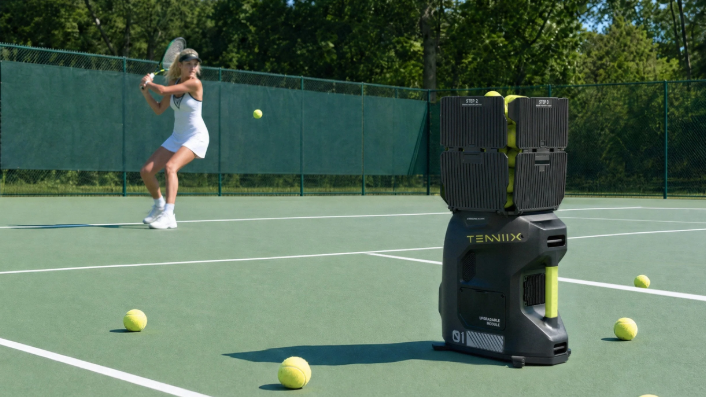
Few training tools change your game as reliably as a tennis ball machine. It never gets tired, never misses, and feeds you exactly the ball you asked for — hundreds of times in a row. But walk into any tennis pro shop and you’ll face a real fork in the road: a simple, affordable basic machine or a feature-packed professional model that costs three to four times more. The wrong choice either starves your practice of challenge or drowns you in settings you’ll never use. This guide to the Basic vs Pro tennis ball machine decision will help you match the hardware to your actual skill level — so every session moves your game forward.
What a Basic Machine Does Well
Basic ball machines are built around one philosophy: repetition. You get a hopper holding 50 to 150 balls, controls for ball speed, feed rate, and a simple oscillation mode that sweeps feeds side to side. That’s it — and for a large slice of players, that is genuinely enough.
A beginner working on a consistent forehand doesn’t need programmable drill sequences; they need 200 forehands at a comfortable pace. A casual weekend player returning after a long break doesn’t need spin simulation; they need rhythm. Basic machines also win on practical grounds: they’re lighter, run longer on a single charge, and are far less likely to malfunction because there is simply less to break. If you play twice a week and your goals are fitness, consistency, and fun, a basic machine delivers excellent value per hour.
What Defines a Pro-Level Machine
Professional machines take over where basics hit their ceiling. The headline feature is programmable shot sequences — drills you can script shot by shot, mixing depth, spin, and direction so the machine reproduces a real rally pattern, like a deep backhand followed by a short forehand slice. Oscillation becomes two-axis: random horizontal and vertical movement, so balls vary in depth as well as width.
Top pro models also add:
- Topspin and backspin controls that replicate the heavy topspin of a modern baseliner or the skidding slice of a net rusher.
- Ball speed ranges up to 80+ mph, matching the pace you’ll face in serious competition.
- Larger hoppers (200–300 balls) and faster feed rates for uninterrupted pressure drills.
- App or remote control, so you can adjust pace mid-drill without sprinting to the other end of the court.
- Performance analytics on the newest models, tracking shot counts, rally length, and even stroke feedback.
Matching the Machine to Your Skill Level
Beginners (NTRP 1.0–2.5)
At this stage, technique is everything and complexity is the enemy. You need slow-to-moderate feeds at predictable heights so you can build clean swing mechanics. A basic machine is the clear winner: it keeps practice simple, lets you focus on footwork and contact point, and leaves budget for lessons — which matter far more than hardware at this level. A pro machine’s spin modes and drill programming would sit unused while you work on simply getting the ball over the net with shape.
Intermediate Players (NTRP 3.0–4.0)
This is where the decision gets interesting. Intermediates have reliable strokes but struggle with variety: the high heavy ball, the low slice, the wide serve return. A basic machine with simple oscillation still serves you well for grooving strokes, but you’ll start feeling its limits — every feed lands at the same height and spin, which breeds comfortable, lazy habits. If you’re playing competitive league tennis and practicing three or more times a week, a mid-range or entry-level pro machine with spin control and two-line drills is worth the jump. If you’re mostly rallying for fun, stay basic.
Advanced and Competitive Players (NTRP 4.5+)
Advanced players don’t practice strokes — they practice situations. Breaking serve against a lefty with a nasty kick serve, defending under pressure, transitioning from defense to attack: these require programmable patterns, variable spin, and match-speed pace. A basic machine simply cannot replicate the shots that beat you in matches. For tournament players, coaches, and academies, the pro machine isn’t a luxury — it’s the practice partner that prepares you for the shots you actually face. The newest AI tennis machine models even adapt drills to your weaknesses, making them closer to a hitting partner than a feeding device.
Key Features Compared Side by Side
| Feature | Basic Machine | Pro Machine |
|---|---|---|
| Ball speed | Up to ~60 mph | Up to 80+ mph |
| Spin control | Flat feeds only | Topspin, backspin, slice |
| Oscillation | Horizontal sweep | Random horizontal + vertical |
| Programmable drills | No | Yes — custom shot sequences |
| Hopper capacity | 50–150 balls | 200–300 balls |
| Remote/app control | Rare | Standard |
| Typical price | $400–$1,000 | $1,500–$4,000+ |
When to Upgrade (and When to Hold Off)
Upgrade when your machine is the limiting factor in practice — you can name specific shots you need to train that it can’t produce. Hold off when your limiting factor is still technique, fitness, or court time; a fancier machine won’t fix a shaky backhand, but 500 focused reps from a basic one will. One smart middle path: buy a basic machine, commit to a full season of structured practice, and reassess. If you outgrow it, basic machines hold resale value well, and you’ll know exactly which pro features your game demands.
Conclusion
The best tennis ball machine isn’t the one with the longest spec sheet — it’s the one that meets you where you are and pushes you one step further. Beginners and casual players get everything they need from a basic machine: rhythm, repetition, and reliability at a price that leaves room for coaching. Intermediates should weigh how seriously they compete before upgrading. And advanced players training for real match situations will get the most from a pro machine’s programmable drills, spin variety, and pace. Match the machine to your level, put in the reps, and the results will follow.
