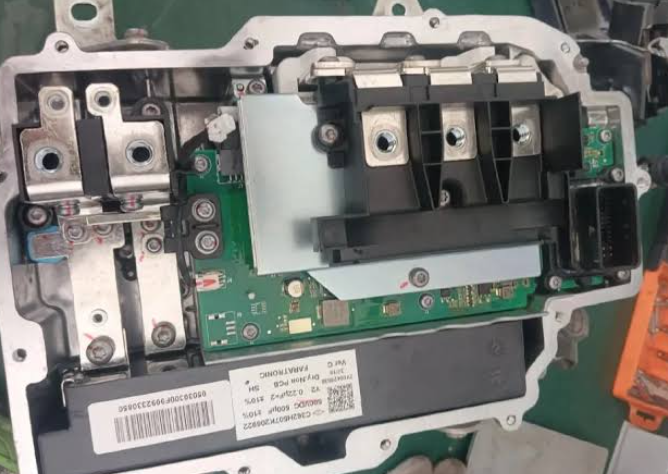
Renewable energy systems have shifted from a supplementary power option to a major component of the global energy mix. Central to this transition is the seamless conversion of naturally variable energy—such as sunlight captured by photovoltaic (PV) panels or wind captured by turbines—into clean, grid-compliant electricity.
Because solar panels produce direct current (DC) that fluctuates continuously with sunlight intensity, the system relies on a central inverter to transform DC power into synchronized alternating current (AC). Achieving conversion efficiencies above 98% requires a tightly coordinated network of power semiconductors. Within this environment, Insulated-Gate Bipolar Transistors (IGBTs) work alongside specialized passive and active components to manage energy transfer with minimal loss.
The Architecture of Power Conversion in Solar Systems
A solar power inverter does not perform DC-to-AC conversion in a single, simple step. Instead, energy flows through several distinct stages designed to maximize solar panel output, stabilize intermediate voltages, and synthesize a smooth AC waveform.
- DC-DC Boost and MPPT Stage: Photovoltaic arrays generate variable DC voltages based on cloud cover, time of day, and temperature. A boost converter stage utilizes high-frequency power switches to step up panel voltage while actively running Maximum Power Point Tracking (MPPT) algorithms to pull the maximum available wattage from the solar array.
- DC Bus Stabilization: The stepped-up voltage feeds into a high-voltage DC bus (typically 600V to 1500V DC). Large capacitor banks smooth out ripple currents to maintain a steady DC reservoir.
- DC-AC Inversion Stage: The stabilized DC voltage is switched rapidly using pulse-width modulation (PWM) across a multi-phase or multi-level inverter bridge. Filters then remove high-frequency switching harmonics, outputting a clean sine wave ready for grid injection or local consumption.
Each stage relies on robust power switching devices engineered to handle high current densities and elevate system efficiency.
How IGBTs Serve as the Core Muscle of the Inverter
While lower-power devices like MOSFETs excel in small-scale microinverters operating at low voltages, high-power string and central inverters operating on 600V to 1500V DC lines rely on IGBTs.
An IGBT combines the simple, voltage-controlled input gate of a MOSFET with the high-current, low-saturation-voltage output characteristics of a bipolar junction transistor. This hybrid structure delivers key advantages in renewable energy conversion:
Low Conduction Losses at High Current
During peak solar generation hours, hundreds of amperes flow through the main inverter bridge. At high voltages, an IGBT’s collector-emitter saturation voltage (VCE(sat)) exhibits much lower conduction losses than the internal drain-source resistance (RDS(on)) of a comparable high-voltage silicon MOSFET. Minimizing heat generation directly increases total kilowatt-hour yield delivered to the grid.
High Voltage Blocking and Transient Endurance
Solar arrays are vulnerable to high-voltage grid transients and localized lightning surges. Commercial-grade IGBTs offer high reverse breakdown voltage ratings (650V, 1200V, or 1700V) and robust short-circuit ride-through capability, protecting the inverter bridge during sudden grid faults.
Optimal Balance for PWM Frequencies
Most central and string inverters modulate power at switching frequencies between 10 kHz and 20 kHz. This frequency range keeps switching losses manageable while shifting switching noise above the human audible spectrum. IGBTs are tailored for this exact operational envelope.
The Interdependent Ecosystem of Inverter Components
An IGBT cannot operate in isolation. Synthesizing AC power efficiently requires a coordinated ecosystem of complementary discrete devices working alongside the primary switches.
Evaluating specialized solar inverter parts highlights how discrete silicon structures interact across the power stage:
Anti-Parallel Freewheeling Diodes
Inductive elements in filters and grid transformers generate high reverse voltage spikes whenever an IGBT turns off. Fast recovery diodes (FRDs) or ultra-fast Schottky diodes are connected in anti-parallel configuration across each IGBT. These freewheeling diodes provide a low-loss path for circulating inductive currents, preventing destruction of the main switches during rapid PWM switching transitions.
Solar String Protection Diodes
Before DC power reaches the inverter, individual panel strings utilize bypass and blocking diodes in their junction boxes:
- Bypass Diodes: Redirect current around shaded or damaged panel cells to prevent destructive “hot spot” formation caused by reverse bias heating.
- Blocking Diodes: Prevent energy stored in grid-tied battery systems or active panel strings from feeding backward into unlit strings during nighttime conditions.
Transient Protection and Auxiliary Rail Control
Auxiliary switch-mode power supplies (SMPS) power the inverter’s internal microcontrollers, sensors, and cooling fans. Small-signal MOSFETs drive these low-voltage auxiliary stages efficiently, while high-surge Transient Voltage Suppression (TVS) arrays protect gate driver lines and communications interfaces against electrostatic discharge (ESD) and voltage spikes.
System Interaction Across a Typical Conversion Cycle
To understand how these components collaborate, consider a typical power conversion sequence during peak sunlight:
| System Operation | Active Components | Functional Goal |
| 1. Solar Panel Capture | PV Arrays, Bypass Diodes | Sunlight generates DC; bypass diodes divert current around shaded cells to protect panels. |
| 2. Voltage Boosting & MPPT | Boost Switches, Ultrafast Diodes | Boost converter steps up variable DC voltage to a stable high-voltage DC bus while tracking peak power. |
| 3. Inverter Bridge Switching | High-Voltage IGBTs | IGBTs rapidly toggle at high frequencies via PWM, chopping the DC voltage into positive and negative pulses. |
| 4. Inductive Freewheeling | Anti-Parallel Fast Recovery Diodes | Discharges reactive energy from filter inductors between IGBT switching intervals, suppressing voltage spikes. |
| 5. Grid Filtering & Protection | LC Filters, TVS Arrays | Transforms chopped PWM pulses into a smooth sine wave; TVS arrays clamp grid voltage transients. |
Thermal Management Best Practices
Power semiconductors generate thermal energy from both static conduction resistance and dynamic switching transitions. In outdoor solar installations where ambient temperatures inside sealed enclosures can reach elevated levels, effective thermal dissipation is essential for system longevity.
- Minimize Junction Thermal Resistance (RJC): High-power IGBTs and diodes should be housed in packages featuring large copper leadframes (TO-247) or mounted directly on isolated ceramic substrate power modules to transfer heat into external heatsinks.
- Optimize Gate Drive Dynamics: Fine-tuning gate resistor values (RG) balances IGBT switching speed against dv/dt voltage overshoot, preventing excessive EMI without introducing switching thermal penalties.
- Distribute PCB Thermal Copper: For surface-mount components in auxiliary supply and protection stages, wide copper pours around component pads help radiate thermal losses into multi-layer PCBs.
See also: Business Success Principles Every Founder Should Know
Final Thoughts
The efficiency and reliability of renewable energy systems depend on how effectively individual power components perform as a unified system. Photovoltaic bypass and blocking diodes safeguard the solar array from shading damage and reverse currents, establishing a stable DC input. Within the inverter, high-voltage IGBTs act as the primary switching engine, converting DC power into grid-compliant AC while anti-parallel freewheeling diodes, TVS arrays, and auxiliary MOSFETs manage energy recirculation and transient defense. By carefully matching electrical specifications, switching speeds, and thermal constraints during system design, engineers build high-yield solar infrastructure capable of delivering reliable clean energy over decades of continuous operation.
